

When people think of Bali, they picture paradise lush jungles, turquoise waves, terraced rice paddies, and temple offerings glowing in the morning sun. It’s a postcard dream, and for many, that’s where the story ends. But behind the beauty lies a far deeper, more complex tale one of ancient kingdoms, foreign invasions, sacred rituals, and a resilient culture that has withstood the tests of time.
Bali’s history isn’t tucked away in dusty museums. It lives in the ceremonies held in village temples, in the quiet chanting at dawn, in the art passed down through generations. To understand Bali today, you need to travel back way back into the island’s layered and fascinating past.
A World Before Time: Bali’s Earliest Roots
Long before Bali became a tourist magnet, it was a land shaped by volcanoes, forests, and rivers and by the hands of its earliest settlers. Archaeological traces suggest that humans have lived here for over 4,000 years, carving out a life in the rich volcanic soil, cultivating rice, and practicing animist rituals tied closely to nature.
But it wasn’t until the first centuries of the Common Era that Bali began to take part in something bigger. Trade routes brought contact with India, and with it came ideas languages, scripts, religions, and a whole new way of seeing the world. Hinduism and Buddhism didn’t replace the local traditions; they blended with them, forming a uniquely Balinese spiritual worldview that still guides life today.
Kingdoms Rise: The Birth of Balinese Power

By the 8th century, Bali had developed into a series of small kingdoms, each ruled by local dynasties who claimed divine ancestry. These weren’t just warlords they were patrons of the arts, builders of temples, and keepers of sacred knowledge. The Warmadewa dynasty, one of the earliest known, left behind inscriptions and temple ruins still standing in central Bali.
But the island didn’t develop in isolation. Across the sea, Java’s powerful kingdoms were rising especially the Majapahit Empire, which at its height in the 14th century controlled much of Southeast Asia. Bali was pulled into its orbit. In 1343, the Majapahit launched a military campaign that brought Bali under its influence, beginning a golden age of cultural exchange.
What followed was a blossoming. The courts of Bali were filled with music, literature, and philosophy. Sacred architecture flourished you can still walk through the majestic temples of this era, like Besakih, known as the “Mother Temple” of Bali. The caste system was formalized, and rituals became more elaborate, intertwining politics, religion, and art into a seamless whole.
The Fall of Majapahit and the Soul of Bali
By the late 1400s, everything changed. The Majapahit Empire began to fall apart as Islam spread across Java. Hindu nobles, priests, and artists fled to Bali, carrying with them their knowledge, customs, and sacred texts. Far from fading away, the culture they brought took root and evolved, thriving in Bali’s relative isolation.
Over the next few centuries, Bali became a cultural stronghold. While the rest of the Indonesian archipelago converted to Islam, Bali remained a sanctuary of Hindu tradition. The island splintered into several small kingdoms Klungkung, Karangasem, Buleleng, and others each competing for power but united by shared customs and religious practices.
This era gave birth to the Bali that still enchants visitors today. Shadow puppet plays, trance dances, temple festivals, and offerings woven from palm leaves all of it became part of daily life. The line between the sacred and the ordinary all but disappeared. Even the rice fields were designed according to spiritual principles, coordinated by temple-based water cooperatives called subak, which are still used today.
First Contact: Foreign Eyes on a Sacred Island
European explorers began appearing in the waters around Bali in the 16th century. The Portuguese were first, but it was the Dutch who would eventually stake a long-term claim. At first, they found Bali difficult to conquer.
The island’s geography, fierce independence, and decentralized power made invasion a logistical nightmare. For centuries, Bali remained just out of reach. The Dutch, focused on controlling the spice trade in other parts of Indonesia, mostly left the Balinese kingdoms alone. But by the 1800s, that began to change. One by one, the Dutch launched military campaigns, slowly bringing the island under colonial rule.
The resistance was fierce. In 1906 and 1908, facing inevitable defeat, Balinese royalty and their followers chose death over submission in a tragic act known as puputan a ritual mass suicide. Dressed in ceremonial white, they walked into gunfire with swords in hand. It was a brutal and heartbreaking moment, one that still haunts Bali’s collective memory.
The Colonial Gaze: Romanticism and Control
After the conquests, the Dutch took a different approach in Bali than elsewhere in Indonesia. They romanticized the island portraying it as a mystical, unspoiled paradise. Ironically, they worked to preserve what they saw as “traditional Balinese culture,” freezing aspects of it in time for their own fascination and, later, for tourism.
In the 1930s, a new wave of Western artists and anthropologists arrived, captivated by the island’s art and spirituality. Painters like Walter Spies and writers like Miguel Covarrubias helped project Bali to the world as an exotic escape, setting the stage for the island’s future as a tourist destination. But behind the romantic image, Bali remained under foreign control. Taxes, land seizures, and political repression continued realities often hidden from the glossy images printed in travel books.
A Legacy That Lives
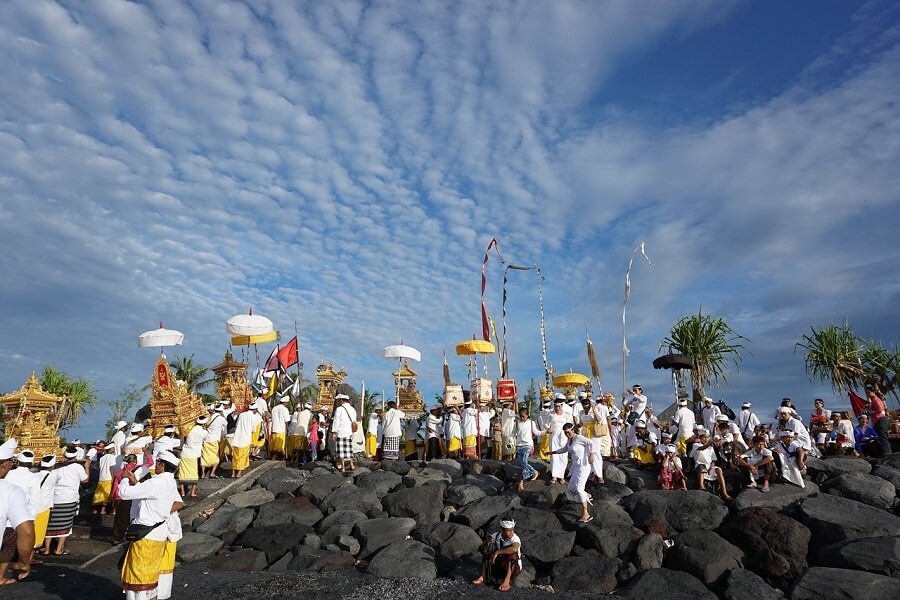
Bali officially became part of the independent Republic of Indonesia in 1950, but its identity has always been distinct. Even as modern life sweeps through the island with Wi-Fi cafes, traffic jams, and yoga retreats the echoes of its ancient past are everywhere. You can see it in the way offerings are laid out every morning, in the sound of a gamelan orchestra during a temple festival, in the intricate carvings that decorate a family compound. The past isn’t just remembered here it’s lived. Understanding Bali means more than enjoying its natural beauty. It means recognizing the island’s deep history one of resilience, reinvention, and sacred continuity. Bali is not just a place you visit. It’s a culture shaped by centuries of triumph and tragedy, still speaking through its rituals, dances, and prayers.
And once you hear that voice, it’s hard to forget.